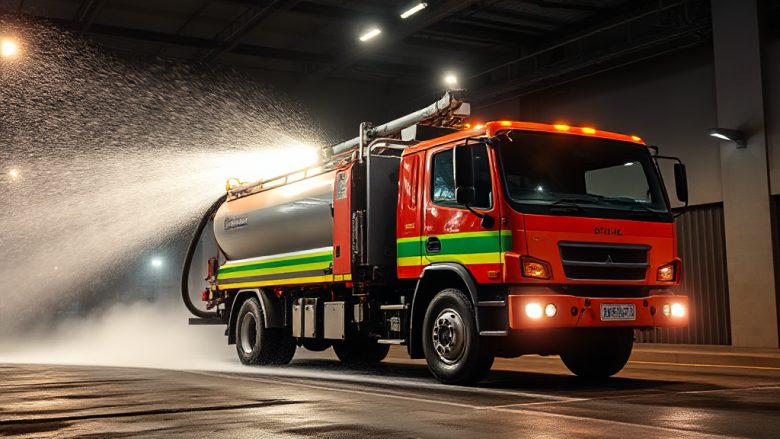
Inside a Hydrojetting Truck: What It Does and When It’s Needed
When a hydrojetting truck pulls up on a tight street in Paraisópolis, the first thing you notice is the hose reel unspooling. A thick, high-pressure line snakes from the rear of the vehicle toward a floor drain or cleanout. What follows is not a plunger on steroids — it is a controlled water-jetting system that uses volume and pressure to restore flow inside a pipe. If you are searching for a desentupidora Paraisópolis São Paulo SP, understanding what the machine actually does helps you judge whether a truck-mounted unit is the right call for your blockage.
What Happens Inside a Hydrojetting Truck
A hydrojetting truck is a self-contained pumping station. A water tank feeds a high-pressure pump driven by the truck’s engine or a dedicated power take-off. The pump pressurizes the water and sends it through a hose reel, a foot valve, and finally a specialized nozzle at the end of the hose. The nozzle does the work: forward-facing jets cut into the blockage, while rear-facing jets propel the hose deeper into the line and flush debris back toward the access point.
The operator controls pressure and flow from a panel near the reel. Most units also carry a water filtration or softening stage, because grit and minerals can destroy pump seals and nozzle orifices. That is why the truck is not just a big hose — it is a pressure vessel, a filtration system, and a metering station on wheels.
Pressure and Flow Ranges You Will See on the Spec Sheet
Hydrojetting performance is usually described by two numbers: pressure (measured in psi or bar) and flow rate (measured in liters per minute or gallons per minute). Pressure alone does not clear a line; you need enough flow to carry the loosened material away. A machine that delivers high pressure with low flow can cut through grease but may leave the debris behind.
Truck-mounted hydrojetting units typically fall into three practical bands:
- Light-duty: around 1,500–2,500 psi and 15–30 L/min. Suitable for small-diameter branch lines and routine maintenance.
- Mid-range: around 3,000–4,000 psi and 30–60 L/min. The workhorse band for residential and light commercial sewer lines.
- Heavy-duty: 4,000 psi and above, with flow rates of 60–100+ L/min. Used for main lines, grease-heavy restaurant laterals, and root intrusion.
These are ranges, not guarantees. The actual performance at the nozzle depends on hose length, elevation, and the nozzle orifice size. A long hose run or a steep lift reduces pressure at the working end, which is why the operator may adjust the pump setting before starting.
Portable Jetter vs. Truck-Mounted Unit: How to Decide
Not every job needs a full truck. Portable electric jetters are smaller, quieter, and easier to move into basements, service corridors, and buildings where a truck cannot park close. They typically deliver lower pressure and flow, which makes them a good fit for short runs, small-diameter pipes, and light grease or soap buildup.
A truck-mounted hydrojetting unit becomes necessary when one or more of these conditions apply:
- Long pipe runs: the blockage is far from the access point, and a portable unit cannot push enough hose or maintain pressure.
- Heavy obstructions: roots, hardened grease, scale, or construction debris that require higher pressure and flow.
- Large-diameter lines: main sewer lines and storm drains that need volume to move material.
- Repeated blockages: a line that keeps clogging often needs full-length jetting, not spot treatment.
For a single slow drain in a house, a portable unit may be enough. For a condominium main line or a commercial kitchen lateral, the truck is usually the correct tool. A reliable desentupidora Paraisópolis will assess the line before recommending one over the other.
Access Constraints in Dense Urban Areas Like Paraisópolis
Paraisópolis is one of São Paulo’s most densely built neighborhoods, with narrow streets, steep gradients, and limited parking. A hydrojetting truck needs a stable footprint, clearance for the hose reel, and a safe path for the hose. In practice, that means the operator may have to park several meters from the access point and run a longer hose, or use a portable unit for the first stretch and a truck for the main line.
Hose length matters here. Every additional meter of hose adds friction loss, which reduces pressure at the nozzle. Experienced operators compensate by choosing a nozzle with a smaller orifice or by staging the job so the truck sits as close as legally and safely possible. They also check for sharp bends, crushed pipe sections, and illegal connections that could snag the hose or cause a backup.
If you are coordinating access for a building, clear the route to the cleanout, confirm that the truck can park without blocking fire lanes, and warn residents about noise and water use. A desentupidora em Paraisópolis São Paulo SP that works in the area regularly will already know these constraints and plan around them.
What the Operator Checks Before the Pump Starts
Before the hose goes in, the operator inspects the access point, confirms the pipe diameter, and selects a nozzle. A nozzle that is too large for the line can stall or damage the pipe; one that is too small wastes flow. The operator also verifies water supply, checks hose couplings for wear, and confirms that the reel brake and foot valve are functioning.
During the job, pressure is monitored and adjusted. If the hose stops advancing, the operator may pull back, change the nozzle, or switch to a different technique. After jetting, a camera inspection or a flow test confirms that the line is clear. The truck then reels in the hose, flushes the system, and prepares for the next call.
Understanding these steps helps you ask better questions when you hire. Ask what pressure and flow the unit delivers, whether the line will be inspected after jetting, and how the company handles access in tight streets. The answers tell you whether you are getting a properly equipped hydrojetting truck or just a hose with a pump attached.