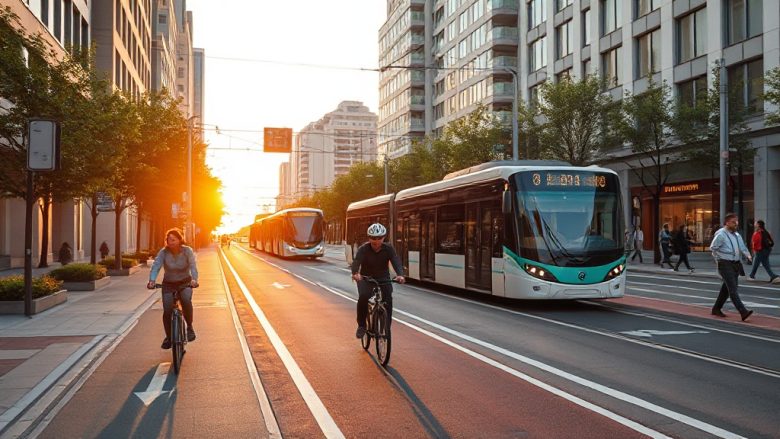
Cities are where the climate fight is won or lost. Urban areas consume roughly two-thirds of global energy and produce over 70 percent of energy-related carbon emissions, and a large slice of that comes from how people and goods move around. The good news is that the menu of sustainable transport options for cities is wider and more practical than it was a decade ago. The hard part is choosing the right mix for a specific place, budget and political reality.
This comparison looks at the main contenders — cycling, e-scooters, buses and rail, electric vehicles, and walking — and weighs them against criteria that actually matter to planners and residents: cost per passenger kilometre, emissions across the full lifecycle, space efficiency, accessibility, and how well each mode performs in dense cores versus sprawling suburbs.
Why Urban Transport Has to Change Now
The case for reform isn’t abstract. Road transport accounts for a significant share of urban air pollution, and fine particulate matter from tyres, brakes and exhaust is linked to respiratory and cardiovascular illness. Congestion also has a brutal economic cost: hours lost, deliveries delayed, buses stuck in the same queues as private cars. When a city’s bus network slows to walking pace, ridership falls, and the whole system enters a downward spiral.
There’s also a spatial argument. A single lane of urban road can move roughly 600 to 1,600 people per hour in cars, depending on traffic. The same lane given to a bus corridor can move several thousand. Given to a protected cycle track, it can move even more during peak periods. Cities that ignore this arithmetic end up paving over green space to store stationary vehicles, which is an expensive way to solve a problem that better mode choice would prevent.
Electrification alone won’t fix it either. Swapping every petrol car for an electric one cuts tailpipe emissions but leaves congestion, road wear, tyre particulates and land consumption largely intact. Sustainable transport options for cities have to reduce the number of trips taken by single-occupancy vehicles, not just change what powers them.
The Main Sustainable Modes, Compared Honestly
Each mode has a sweet spot. Treating any of them as a universal answer is where urban transport policy usually goes wrong.
Walking is the cheapest, cleanest and most equitable mode. It requires almost no infrastructure beyond safe footways, lighting and crossings. Its limitation is range: most people will walk 1 to 2 kilometres comfortably, which covers a surprising share of urban trips but not the commute from a suburban estate to a city-centre office.
Cycling extends that range to roughly 5 to 10 kilometres with modest effort, and e-bikes push it to 15 kilometres or more. The catch is that cycling only scales when protected infrastructure exists. Paint on asphalt doesn’t attract nervous riders, and the people who would benefit most — older residents, parents with children, shift workers — are exactly the ones who won’t ride in mixed traffic. A connected network of protected lanes costs far less per kilometre than a metro extension, which makes it one of the highest-return investments available to a mid-sized city.
E-scooters and shared micromobility solve the first-and-last-mile gap. They’re fast to deploy, popular with younger commuters, and genuinely useful for connecting a rail station to an office park. The downsides are real: batteries have a limited service life, vehicles get vandalised or dumped, and unmanaged parking creates trip hazards for wheelchair users and blind pedestrians. Cities that regulate parking zones and cap fleet numbers get much better results than those that simply ban them.
Buses remain the workhorse of sustainable urban transport. A modern electric bus produces no tailpipe emissions, carries 60 to 90 passengers, and can be rerouted as the city grows. Bus rapid transit with dedicated lanes and priority signalling delivers metro-like reliability at a fraction of metro cost. The weakness is political: bus lanes take road space from drivers, and that fight is rarely pleasant.
Trams, light rail and metros offer the highest capacity and the strongest signal to developers that a corridor is worth building along. They also cost the most, take the longest to deliver, and only pay off where density is already high or planned. A tram through low-density sprawl is an expensive white elephant; the same tram through a dense inner suburb can reshape a city’s economy.
Electric vehicles matter, but mostly at the margins. They’re the pragmatic answer for delivery vans, taxis, car-sharing fleets and residents in rural or peri-urban areas with no realistic alternative. For dense urban cores, they’re a complement to public transport, not a substitute. Cities that pour subsidies into private EV purchases while neglecting bus frequency usually find they’ve spent a lot of money to keep congestion exactly the same.
Comparing the Options: A Practical Summary
| Mode | Best suited to | Relative cost | Key strength | Main drawback |
|---|---|---|---|---|
| Walking | Dense cores, short trips | Very low | Equitable, zero emissions | Limited range |
| Cycling / e-bikes | Inner and mid-distance suburbs | Low | High return on infrastructure spend | Needs protected networks |
| E-scooters | Station-to-destination links | Low to moderate | Fast deployment | Parking and battery waste |
| Buses / BRT | Most cities, all densities | Moderate | Flexible, scalable capacity | Needs priority over traffic |
| Trams / light rail / metro | High-density corridors | High | Very high capacity | Slow, costly to build |
| Electric vehicles | Fleets, low-density areas | Moderate to high | Cuts tailpipe emissions | Doesn’t reduce congestion |
Read that table as a starting point, not a verdict. The right answer for a coastal city with narrow medieval streets looks nothing like the right answer for a car-dependent Sun Belt metropolis. Context decides.
Matching Modes to Different City Contexts
Dense historic cores with tight streets and strong transit traditions should prioritise walking, cycling and bus priority. There’s rarely room for more cars, and the tourism and retail economies benefit directly from pedestrianised streets. Low-emission zones and congestion charging can fund the bus improvements that make the whole package politically survivable.
Low-density, car-oriented cities face a harder task. Cycling alone won’t shift behaviour when destinations are 20 kilometres apart. The realistic sequence is express bus corridors on arterial roads, park-and-ride hubs at the edges, protected bike lanes feeding into those hubs, and zoning reform that allows more homes near transit stops. Without the zoning piece, the transit investment underperforms.
Rapidly growing cities in the Global South often have the most to gain. They’re building infrastructure now, so they can avoid locking in car dependence for fifty years. Bus rapid transit, commuter rail and dense, mixed-use development along corridors are far cheaper than retrofitting a sprawling city later. Informal transport — minibuses, shared taxis — shouldn’t be ignored; formalising and electrifying it is often more effective than trying to replace it.
Cold-climate and hilly cities need honest answers too. Winter maintenance for cycle lanes isn’t optional, and steep gradients make e-bikes and funicular or cable transit more attractive than ordinary bicycles. Ignoring these realities produces policies that look good in a strategy document and fail in February.
Funding, Politics and the Equity Question
Money is the perennial constraint, but the funding tools are well understood. Congestion charges, parking levies, fuel duties, developer contributions and national climate funds can all feed a dedicated transport budget. The key is hypothecation: drivers accept charges far more readily when the revenue visibly improves buses and cycle lanes rather than disappearing into general spending.
Equity deserves more attention than it usually gets. A bus fare that rises faster than wages pushes low-income riders off the network. Cycling infrastructure that only reaches affluent neighbourhoods widens the gap. Electric vehicle subsidies that mostly benefit wealthier households are regressive. A fair sustainable transport strategy measures who gains access, not just how much carbon is saved.
Politics is the other hurdle. Road space is contested, and any reallocation generates vocal opposition. Cities that succeed tend to phase changes, communicate clearly, and let people experience the improvement before the next stage. Temporary bike lanes and bus lanes that become permanent after a trial period are a proven tactic, because they turn an abstract argument into a lived one.
Frequently Asked Questions
Which sustainable transport option gives the best value for money?
For most cities, protected cycling networks and bus priority deliver the largest emissions and congestion reductions per pound spent. Rail and metro offer higher capacity but cost many times more per kilometre and take years longer to deliver. The best value usually comes from combining cheap, fast interventions with one or two strategic high-capacity projects.
Are electric vehicles part of the solution or a distraction?
Both, depending on where they’re used. For delivery fleets, taxis, car sharing and low-density areas, electrification is genuinely useful and often the only practical option. In dense city centres, private electric cars still cause congestion, road wear and particulate pollution, so they should complement public transport rather than replace it.
How can a city start without a huge budget?
Begin with low-cost, high-visibility measures: bus lanes with camera enforcement, temporary cycle lanes, safer crossings, and better lighting on walking routes. These can be delivered within a year and generate the political momentum and data needed to justify larger investments later. Cheap first, ambitious second is a workable sequence.
Do e-scooters actually reduce emissions?
They do when they replace car trips and last long enough to offset manufacturing emissions. They can increase emissions if they mainly replace walking or cycling, or if fleets are replaced every few months. Regulating vehicle lifespan, requiring battery recycling and managing parking are the levers that tip the balance the right way.
The honest conclusion is that no single mode wins. Sustainable transport options for cities work best as a system: walkable streets, protected cycle routes, reliable buses, rail where density justifies it, and electric vehicles where nothing else fits. Cities that treat these as competing factions tend to stall. Cities that treat them as one network tend to move.